
See AI at Work: Introducing the Agents Office
If you’ve trialed AI but worry about the black box, make the work visible. ZopiTech’s Agents Office shows how AI agents collaborate, wait on tasks, escalate, and report status—plus a practical roadmap to fold them into real processes with controls.
The real tension: AI that promises, operations that demand control
Many enterprises already have AI pilots: a support chatbot, a sales assistant, or a script that summarizes tickets. The value is visible—sometimes.
The operational questions remain: What exactly is the AI doing? When does it need human help? How do we audit its decisions? When does it escalate—and to whom? How does it connect to our APIs and production workflows without increasing risk?
When there is no visibility or control, AI becomes a black box that is difficult to govern and difficult to scale.
The right question is not simply “Which model should we use?” but:
How do we make the work of AI agents visible and manageable within our business processes?
What the Agents Office is — and what it isn’t
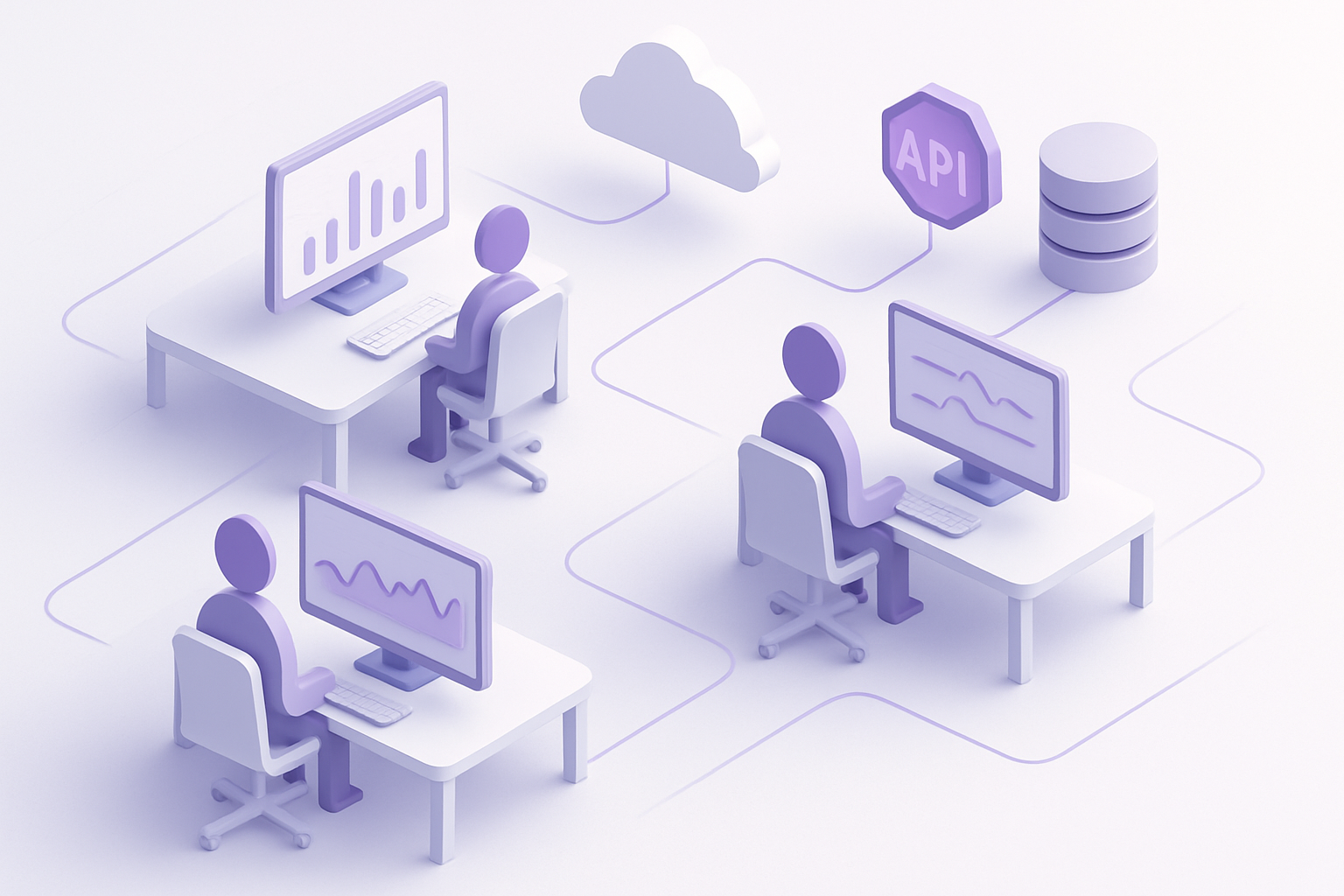
The Agents Office is an operational representation of a team of AI agents working together.
It is not just a 3D demo.
It is an interface designed to:
- Visualize specialized agents across sales, support, infrastructure, cybersecurity, development, analytics, and orchestration, with real-time states such as active, waiting, blocked, requesting help, reviewing evidence, or running tests.
- Understand collaboration flows: who picks up a task first, who validates it, who orchestrates the process, and when work is handed over to a human.
- Observe queues, priorities, and task context together with associated traces and artifacts such as logs, diffs, attachments, and metrics.
- Define human-in-the-loop checkpoints and clear escalation policies.
Our vision is to progressively connect these agents to APIs, systems, data, and real business processes, so what you see in the Office reflects the work that is actually happening: what agents are doing, what outcomes they generate, and when human intervention is required.
If we can observe a human team working in an office, we can also make the work of AI agents visible.
Explore the ZopiTech Agents Office
Business outcomes it unlocks
The primary value is operational: visibility, control, and continuous improvement.
- Transparency and auditability: every action can be traced. You can review why an agent followed a particular path, which sources it consulted, and what actions it performed.
- Human–agent coordination: define when to hand work over, which thresholds trigger human review, and how cases are closed.
- Governance and compliance: establish data-access policies, domain segmentation, and post-action review for sensitive decisions.
- Capacity and SLA management: by making queues and processing times visible, you can identify where additional capacity is needed—agents or people—and where prompts, tools, or integrations should be optimized.
Examples
- Sales and support: agents that prioritize leads, prepare proposals using current data, and escalate regulatory questions or sensitive decisions to an executive.
- Infrastructure and DevOps: agents that monitor alerts, perform initial diagnostics, propose mitigations, and request approval before executing changes.
- Cybersecurity: agents that correlate events, enrich them with threat intelligence, and create incidents with supporting evidence already attached.
- Development and analytics: agents that generate code changes, automated tests, and impact summaries, while keeping human validation where required.
- Orchestration: a coordinator agent that distributes work, manages dependencies, consolidates results, and reports operational metrics.
How it connects to your systems
Start small.
Start safely.
- Controlled environment with synthetic data: define processes, rules, and intervention policies. Measure time and quality without touching production.
- Integration with work tools: ticket queues, task managers, source repositories, observability platforms, and data stores.
- Connection to critical APIs and systems: CRM, ERP, ITSM, CI/CD, SIEM, and other business systems using least privilege and reinforced monitoring.
- Operation and continuous improvement: refine prompts, tools, models, and autonomy limits based on real operational evidence.
This approach combines our capabilities across software development, integrations and APIs, applied AI, cybersecurity, DevOps, Linux, cloud, IoT, telemetry, monitoring, and operational continuity.
Learn more about our capabilities at ZopiTech Services and explore the kinds of challenges we address in our Case Studies.
Adoption criteria and trade-offs
Not every process is an immediate candidate for agent-based automation.
Good candidates
- High-volume processes with sufficiently clear rules, such as L1 support, initial diagnostics, reconciliations, or basic QA.
- Reliable data sources that can be accessed through APIs or controlled integrations.
- Decisions that can be audited and, when necessary, rolled back.
- Processes where the boundaries between autonomous action and human approval can be clearly defined.
Use caution when
- The task is strategic, highly contextual, or carries significant reputational impact and cannot be reviewed beforehand.
- There is no clear process owner or baseline metrics, making improvement difficult to measure.
- Sensitive data is involved and adequate access controls, anonymization, or traceability mechanisms are not yet in place.
Common trade-offs
- Speed vs. control: more autonomy increases speed, but can also increase risk. Define clear intervention thresholds.
- Cost vs. quality: more human validation may improve quality, but it also increases operational cost.
- Flexibility vs. standardization: highly flexible prompts and tools support experimentation but can make governance more difficult.
Red flags
- “We want AI because everyone else has it.” Without a concrete problem to solve, the Office becomes little more than a showroom.
- Lack of observability. Without logs, metrics, and traces, there is no solid foundation for continuous improvement.
- Opaque dependency on a single provider. The architecture should support portability across models, tools, and integrations.
Governance, security, and observability from day one
An AI-agent architecture should include operational controls from the start:
- Least privilege and segmentation by domain or system.
- Secure management of secrets, credentials, and keys, including rotation and usage logging.
- Data protection through anonymization or pseudonymization where appropriate.
- Full observability using metrics, logs, and traces per task and per agent.
- Actionable auditability: every output should be linked to its sources, actions taken, and responsible party.
- Clear separation between autonomous decisions and those requiring human approval.
Metrics to make data-driven decisions
AI-agent adoption should be measured.
Relevant metrics include:
- Lead time by task type.
- First-pass resolution rate.
- SLA attainment.
- Backlog and average queue time.
- Cost per transaction, including model usage, infrastructure, and human effort.
- Net savings compared with the operational baseline.
- Error rate and findings during review.
- Internal user or customer satisfaction.
- Number and type of escalations.
- Incidents avoided.
- Changes reverted or rejected during human validation.
The goal is not simply to replace people with agents.
The goal is to increase operational capacity, speed, and quality while maintaining visibility and control over what is happening.
Suggested implementation roadmap
1. Discovery and design
Select one or two candidate processes, identify the systems involved, define intervention policies, and establish baseline metrics.
2. Functional prototype
Build the flow inside the Agents Office using synthetic data and a limited set of tools.
The objective is to validate behavior, agent collaboration, observability, and governance.
3. Connected pilot
Progressively integrate non-production environments and then a tightly scoped production process using least privilege and reinforced monitoring.
4. Operate and improve
Review metrics, adjust autonomy levels, add new tools, and onboard additional agents based on real operational needs.
See it in action
If you are exploring how to apply AI while maintaining visibility, operational control, and the ability to intervene, take a look at our Agents Office.
Explore the ZopiTech Agents Office
You can also:
- Learn more about our capabilities at ZopiTech Services.
- Explore projects and references in our Case Studies.
- Contact us to discuss the scope, risks, integrations, and metrics for an initial pilot.
---
The office is virtual. The operations behind it are real.
The goal is not to add technology for its own sake, but to understand the problem, simplify the path and build what creates value.
Turn the idea into an implementation plan.
We can review your context, constraints and the fastest path to value.