
Two difficult weeks for the Internet: PHP2Shell, Java, Node.js and digital trust
PHP2Shell, critical Java and Node.js fixes, GitLab vulnerabilities and software supply-chain attacks made October 2026 a challenging month. Here's what to review.
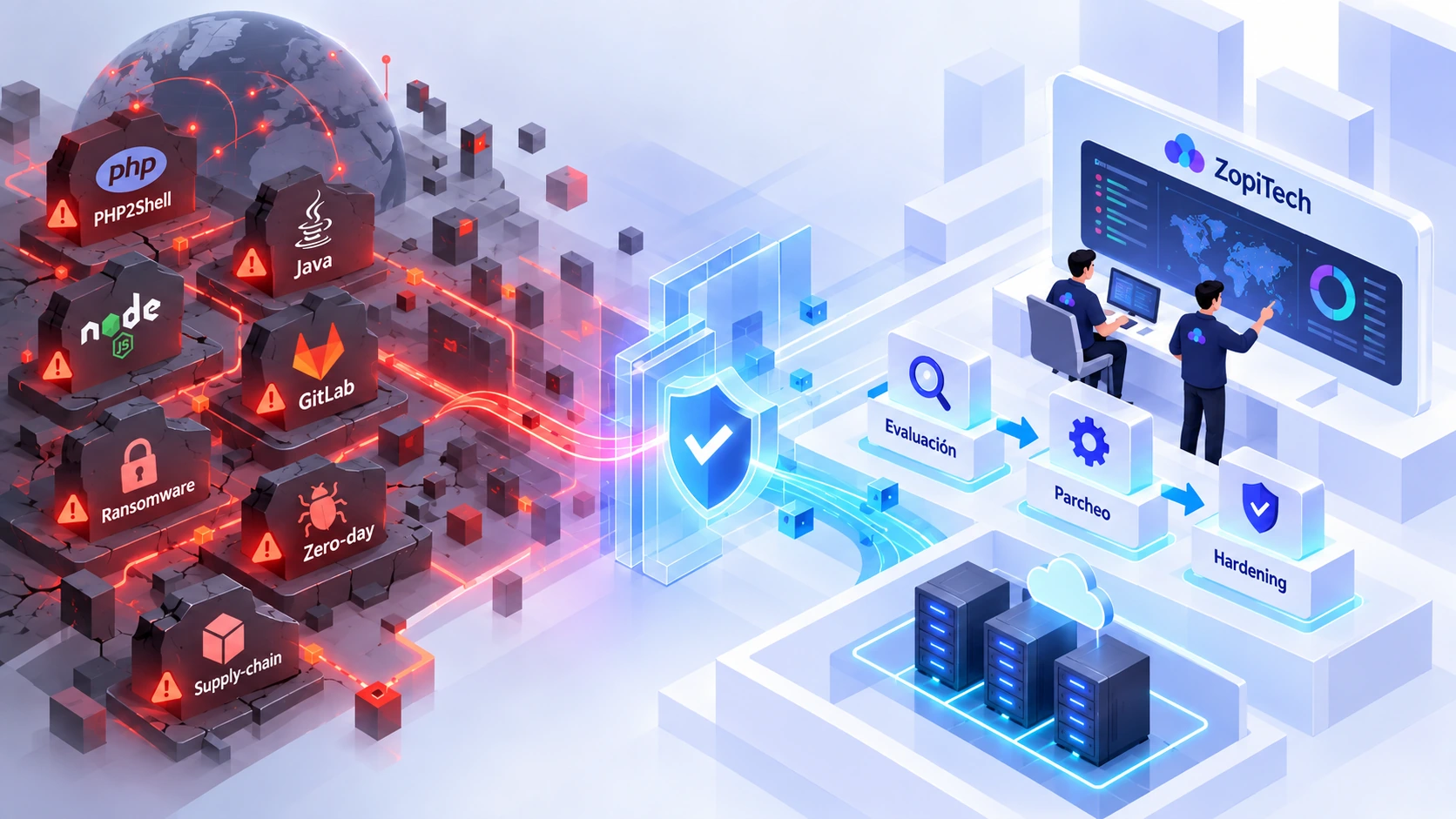
Between October 10 and 24, 2026, security warnings arrived from several layers of the Internet: PHP, Java, Node.js, GitLab, third-party packages and HTTPS certificate infrastructure. These were not all part of one attack. Together, however, they expose an uncomfortable truth: an application can be well built and still be vulnerable through the technology it depends on.
For organizations, the useful question is not simply how many CVEs were disclosed. It is whether they know where these technologies run, what is actually exposed and how to remediate the risk without disrupting operations.
Two weeks, several kinds of risk
| Date | Event | Why it matters |
|---|---|---|
| October 14 | PwnEscape / Linux KVM | Research into virtual machine isolation and kernel remediation. |
| October 17–20 | eMudhra | Eight subordinate CA certificates were associated with weak private keys. |
| October 20 | Oracle Java SE | 55 security patches, including 49 vulnerabilities potentially exploitable remotely without authentication under relevant conditions. |
| October 21 | PHP2Shell | Two critical PHP-core issues with potential unauthenticated remote code execution. |
| October 21 | Node.js | Ten security fixes, including a flaw in Brotli decompression. |
| October 21 | GitLab | A potentially unauthenticated code execution vulnerability rated CVSS 10.0. |
| October 21 | LiteLLM | Compromised official packages and container images distributed credential-stealing malware. |
Important: this timeline combines advisories, research and a confirmed malicious distribution incident. It does not mean that all flaws have been exploited at scale or every affected organization was breached.
PHP2Shell: a vulnerable runtime can undermine a healthy application
On October 21, the PHP project released emergency security updates for CVE-2026-109618 and CVE-2026-109619, two PHP-core vulnerabilities that may enable unauthenticated remote code execution.
The weakness does not necessarily originate in Laravel, WordPress or custom business code. An application may pass code-level security reviews while its interpreter remains vulnerable.
The minimum fixed releases for supported branches are:
| PHP branch | Minimum corrected version |
|---|---|
| 8.5 | 8.5.12 |
| 8.4 | 8.4.27 |
| 8.3 | 8.3.36 |
| 8.2 | 8.2.35 |
PHP maintainers explicitly stated that no complete mitigation replaces upgrading. Unsupported releases call for a migration plan or verified vendor-provided extended patch support.
What to review: PHP-FPM processes, application containers, test environments reachable from the Internet, scheduled tasks and secondary services. Verify the interpreter actually serving each application: a CLI version check alone may not describe the web runtime.
Security vendors reported a large potential exposure surface and proof-of-concept activity. Potential vulnerability is not evidence of confirmed compromise.
Java: the challenge of long-lived enterprise applications
Oracle's October Critical Patch Update included 55 fixes for Java SE. Oracle reported that 49 vulnerabilities may be remotely exploitable without authentication under the applicable technical conditions.
Java often runs behind the scenes: integrations, scheduled processes, packaged enterprise products and legacy applications. These systems may work for years without much change, but operational stability should not be mistaken for security.
What to review: installed JDK/JRE versions, bundled runtimes, container base images, dependency inventories and accountable system owners. Test vendor updates in staging, evaluate compatibility and prepare rollback before touching business-critical processes.
Secure maintenance means knowing what exists, prioritizing by exposure and validating every change.
Node.js and npm are not the same security layer
On October 21, Node.js issued security updates for versions 22, 24 and 26: 22.23.4, 24.22.1 and 26.12.1.
Among the issues was CVE-2026-111497, a vulnerability in the Brotli decoder. Malformed compressed data processed by an application could corrupt memory and, under certain conditions, lead to remote code execution. Additional corrections covered DNS handling, TLS certificate verification, random-value caches in snapshots and filesystem permissions.
Node.js is the runtime. npm is an ecosystem of dependencies. Updating packages does not automatically patch the Node.js executable; updating the runtime does not automatically make every dependency trustworthy.
Just before this article's two-week window, a malicious tensorlake 0.5.144 package was distributed through npm on October 8. Its maintainers described credential theft triggered during installation through a compromised legitimate release process. The malicious version even carried valid provenance. This is a practical warning: proof of where an artifact came from is not proof that its content is safe.
What to review: actual runtime versions, lockfiles, installation scripts, package publishing privileges and CI/CD credentials.
GitLab: software delivery infrastructure is security-critical
On October 21, GitLab patched CVE-2026-110264, a flaw related to regular-expression compilation that, under certain conditions, could permit unauthenticated code execution. GitLab assigned a CVSS 10.0 rating.
Corrected releases include 18.11.13, 19.0.10, 19.1.9, 19.2.9, 19.3.6, 19.4.3 and 19.5.1. The company advised self-managed customers to update promptly and provided indicators useful for detecting exploitation attempts.
A GitLab installation may hold source code, CI/CD variables, runner credentials and keys used to access production. These are possible consequences to assess, not proof that such assets were exposed in every case.
What to review: installed version, network exposure, privileged accounts, runners, secrets, audit trails and a verified backup before applying the update.
LiteLLM: trusted distribution can be abused
On October 21, the LiteLLM release process was compromised. Version 1.107.0 was distributed through PyPI and official container registries with code designed to steal credentials.
In a reconstruction published on October 23, the maintainers described how privileged stolen credentials were used to modify the release pipeline's source. The affected PyPI packages were available for approximately two hours.
Researchers found malicious execution paths triggered at Python startup, even when an application did not explicitly import LiteLLM. If an affected environment executed this release, simply uninstalling it is not a sufficient investigation. Teams should inspect installed artifacts and images, rebuild from known-good sources, search for indicators and rotate secrets that may have been accessible.
A familiar package name and an official registry are useful signals, but they are not an absolute guarantee of benign content.
eMudhra and PwnEscape: beneath application code
In mid-October, weak randomness was identified in private keys associated with eight eMudhra subordinate CA certificates. Google documented steps to block trust in affected certificate authorities. The concern was the possibility of forging HTTPS certificates against clients that still trusted the keys. This does not establish widespread interception.
In a different infrastructure layer, PwnEscape research investigated a KVM guest-to-host escape issue in Linux and prompted kernel remediation work. Whether a particular deployment remains vulnerable depends on its configuration, kernel lineage and distribution backports.
HTTPS and virtualization remain valuable controls, but neither eliminates the need to maintain the software implementing them.
What should an organization do in the next 72 hours?
The right response is not to apply every patch blindly or shut down systems without assessing operational consequences. Start with a controlled cycle:
- Inventory: internet-facing services, applications, runtimes, containers, repositories, pipelines and dependencies.
- Verify: confirm versions in running processes, not just installed packages; account for vendor backports.
- Prioritize: address exposed services and systems handling important data or credentials first.
- Prepare: take backups, test compatibility, and define safe rollback procedures.
- Remediate: apply verified patches and confirm production is actually loading the corrected software.
- Investigate: inspect logs, suspicious artifacts, privileged-account changes and unusual use of secrets; escalate evidence through incident response.
- Document: record affected assets, owners, remediation, verification evidence and remaining exceptions.
Success is not just the number of installed patches. It means being able to answer: what was exposed, what changed and how do we know the fix worked?
What these weeks teach us
PHP2Shell highlights runtime risk. Java illustrates the responsibility of maintaining enterprise software over time. Node.js reinforces the difference between a runtime and its dependencies. GitLab shows that development infrastructure must be defended. LiteLLM challenges blind trust in official release channels. eMudhra and PwnEscape point toward the foundations of TLS and virtualization.
No single product can eliminate all security risks. Effective protection depends on asset visibility, least privilege, tested upgrades, continuous monitoring and readiness to respond.
Security does not end when an application goes live. It remains a responsibility throughout the software lifecycle.
ZopiTech: assess, prioritize and remediate
At ZopiTech, our cybersecurity and infrastructure capabilities help organizations assess existing applications and servers, identify exposed technologies and versions, prioritize security findings and define an actionable remediation plan.
Where appropriate, we also support controlled patching, hardening, post-change validation and follow-up, with operational continuity as a central requirement.
You do not need to experience an incident before understanding your exposure. A focused technical assessment can clarify what needs urgent attention, what should be tested and what requires a longer modernization plan.
Sources and further reading
- PHP: October 21 security releases
- Palo Alto Networks: PHP2Shell
- Oracle: October 2026 Critical Patch Update
- Node.js: October security updates
- GitLab: October critical patch release
- LiteLLM: security incident and response
- LiteLLM: attack-chain reconstruction
- Google: eMudhra certificates
- PwnEscape: technical research
- TensorLake: October 8 npm advisory
Information reviewed through October 24, 2026. Always consult current vendor advisories and verify the conditions of the actual environment before making changes.
The goal is not to add technology for its own sake, but to understand the problem, simplify the path and build what creates value.
Turn the idea into an implementation plan.
We can review your context, constraints and the fastest path to value.